
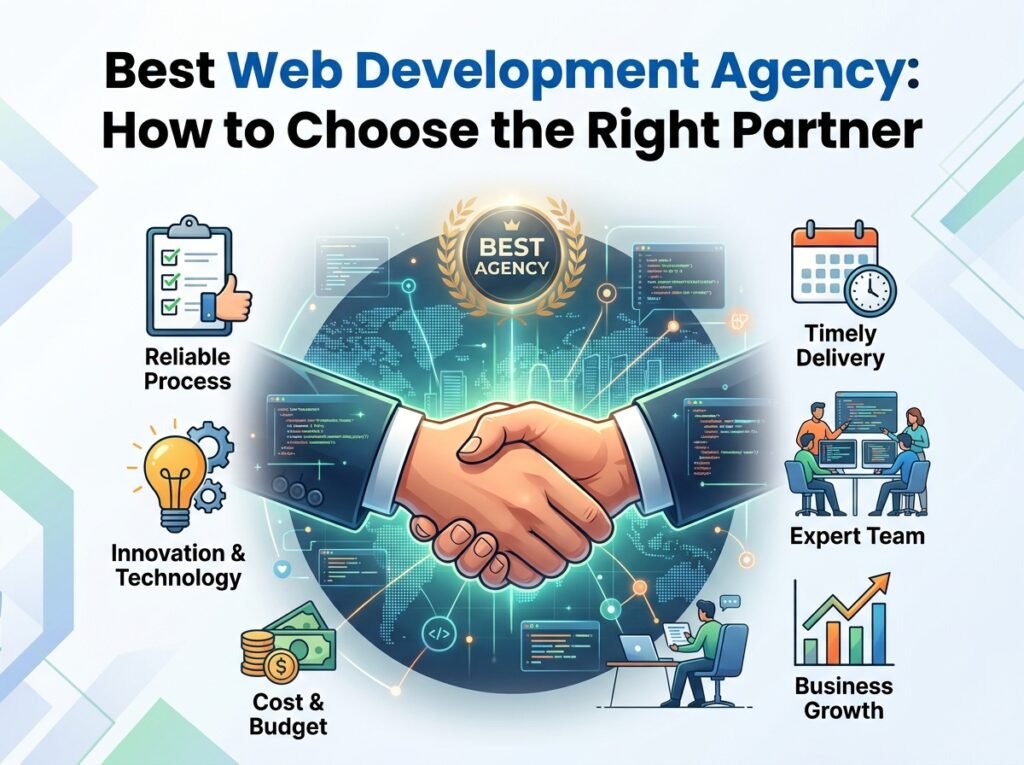
Best Web Development Agency: How to Choose the Right Partner
Choosing the best web development agency is an important decision for any business that wants to build a strong online presence. Your website is more than an online brochure. It can be your primary sales channel, lead-generation system, e-commerce store, customer service platform, and first interaction with potential customers.
With hundreds of web development companies offering different services, technologies, prices, and packages, choosing the right partner can quickly become confusing. A professional-looking portfolio does not always mean an agency understands your business goals, and the lowest price does not necessarily provide the best long-term value.
The right web development agency should understand your objectives, target audience, industry, technology requirements, SEO needs, and future growth plans. It should also be able to communicate clearly and provide ongoing support after the website goes live.
This guide explains what to look for when choosing a web development partner and how to evaluate an agency before starting your project.
What Does a Web Development Agency Do?
A web development agency designs, develops, maintains, and improves websites and web-based platforms for businesses. Depending on the agency, services may include website design, custom development, WordPress development, e-commerce development, CMS development, website maintenance, performance optimization, integrations, and technical SEO.
A good agency combines design, development, user experience, performance, security, and business objectives.
For example, a company launching a service-based website may need a professional WordPress website with lead-generation forms and SEO-friendly architecture. An online retailer may require a complete e-commerce platform with product management, payment integration, shipping functionality, analytics, and conversion optimization.
You can explore professional web development services to understand the types of solutions a business may require.
Why Choosing the Right Web Development Agency Matters
Your website can directly influence how customers perceive your business. A slow, confusing, outdated, or difficult-to-use website can create friction and cause potential customers to leave before contacting you.
On the other hand, a well-developed website can help you:
- Build credibility and trust
- Generate qualified leads
- Increase online sales
- Improve user experience
- Support search engine visibility
- Present your products and services professionally
- Integrate marketing and analytics tools
- Create a scalable foundation for future growth
The agency you choose can therefore affect more than the website itself. It can influence your marketing performance, customer experience, maintenance costs, and ability to expand your digital presence.
1. Define Your Website Goals Before Choosing an Agency
Before contacting a web development agency, clearly define what you want your website to accomplish.
Ask yourself:
- Is the website designed to generate leads?
- Do you want to sell products online?
- Do you need a corporate website?
- Do you need a booking or appointment system?
- Will customers create accounts?
- Do you need third-party integrations?
- Do you plan to publish content regularly?
- Do you expect significant traffic growth?
- Do you need multilingual functionality?
For example, a small service company may primarily need lead generation, while an e-commerce business may need advanced product filters, payment gateways, inventory management, and customer accounts.
Having clear objectives allows you to compare agencies based on your actual requirements rather than simply comparing prices.
2. Review the Agency’s Portfolio
One of the easiest ways to evaluate a web development agency is to review its previous projects.
Do not only look at whether the websites appear visually attractive. Examine how the websites work.
Check:
- Website speed
- Mobile responsiveness
- Navigation
- Page structure
- Calls to action
- Forms
- Product pages
- Content organization
- User experience
- Technical functionality
You should also determine whether the agency has experience working with businesses similar to yours.
A developer who specializes in simple brochure websites may not be the right choice for a complex e-commerce platform. Similarly, an agency focused primarily on design may not have the technical expertise required for custom integrations.
3. Check Technical Expertise
Web development involves much more than creating attractive pages.
Depending on your project, an agency may need expertise in:
- WordPress
- WooCommerce
- Shopify
- PHP
- JavaScript
- React
- Next.js
- APIs
- Databases
- Cloud hosting
- Website security
- Performance optimization
- Analytics
- Third-party integrations
Ask the agency which technologies it recommends and, more importantly, why.
A good development partner should select technology based on your requirements rather than simply using whatever platform the team is most comfortable with.
For example, WordPress may be suitable for a content-focused business website, while WooCommerce or Shopify may be more appropriate for an online store.
4. Consider E-Commerce Experience
If your business sells products online, choosing an agency with strong e-commerce experience is particularly important.
An e-commerce website needs more than product pages. It may require:
- Product catalogs
- Categories and filters
- Shopping carts
- Payment gateways
- Shipping integrations
- Inventory management
- Customer accounts
- Order management
- Discount systems
- Email notifications
- Analytics
- Conversion optimization
- Security
A poorly developed online store can create problems throughout the customer journey.
For businesses planning to sell products online, dedicated e-commerce development services can help create a website designed around online sales and customer experience.
5. Make Sure SEO Is Considered During Development
One common mistake businesses make is treating SEO as something that happens after the website is built.
Technical SEO should be considered during development.
Important areas include:
- Website architecture
- URL structure
- Page speed
- Mobile usability
- Internal linking
- Heading structure
- Metadata
- Image optimization
- Indexability
- XML sitemaps
- Canonical URLs
- Structured data
- Core Web Vitals
- Crawlability
A beautiful website that search engines cannot efficiently crawl or understand can create unnecessary SEO challenges.
If organic search is an important part of your growth strategy, your development partner should understand how development decisions affect SEO. You can also integrate development with dedicated search engine optimization services to build a stronger long-term organic search strategy.
6. Evaluate Website Performance
Website performance affects both user experience and digital marketing.
Users expect websites to load quickly, especially on mobile devices. Slow pages can increase abandonment and make it harder for visitors to find the information they need.
Ask prospective agencies how they approach:
- Image optimization
- Caching
- Code optimization
- JavaScript loading
- CSS optimization
- Hosting configuration
- Content delivery networks
- Database optimization
- Mobile performance
Do not accept vague statements such as “the website will be fast.” Ask how performance will be measured and optimized.
7. Check Mobile Responsiveness
A modern website must work properly across different screen sizes.
Your website should provide a consistent experience on:
- Smartphones
- Tablets
- Laptops
- Desktop computers
Check the agency’s previous websites on mobile devices. Look for problems such as tiny buttons, difficult navigation, horizontal scrolling, oversized images, slow-loading elements, or forms that are difficult to complete.
Responsive design should be part of the development process, not an optional feature added at the end.
8. Ask About Security
Website security is another important consideration when selecting a development partner.
Depending on your platform and project, security measures may include:
- Secure authentication
- SSL/HTTPS
- Regular updates
- Secure coding practices
- Malware protection
- Backup systems
- Access control
- Plugin management
- Vulnerability monitoring
For e-commerce websites and websites handling customer information, security becomes even more important.
Ask the agency how it handles security during development and what happens if a security issue appears after launch.
9. Understand the Development Process
A professional agency should have a clear development process.
A typical project may include:
- Discovery and requirements
- Sitemap and information architecture
- Wireframing
- UI/UX design
- Development
- Content implementation
- Testing
- SEO and performance checks
- Client review
- Launch
- Post-launch support
Ask who will be responsible for each stage.
You should also understand how revisions work. Some agencies include a specific number of revisions, while others charge separately for changes outside the original scope.
A clearly defined process helps prevent misunderstandings and unexpected costs.
10. Evaluate Communication
Communication can make or break a web development project.
Before hiring an agency, determine:
- Who will be your main contact?
- How frequently will you receive updates?
- How will feedback be provided?
- What project management system will be used?
- How quickly does the agency respond?
- Who approves major changes?
You want a partner that can explain technical decisions in understandable language.
Good communication is especially important when the project involves custom functionality or multiple teams.
11. Understand the Total Cost
Price should be considered, but it should not be the only factor.
A website’s cost may depend on:
- Number of pages
- Design complexity
- Custom functionality
- CMS requirements
- E-commerce functionality
- Integrations
- Content requirements
- SEO requirements
- Hosting
- Maintenance
- Security
- Third-party software
Ask for a detailed proposal rather than accepting a single number.
A very cheap quote may exclude important services that you later have to purchase separately. A higher quote may include custom functionality, better support, or ongoing optimization.
The goal is to understand the value and scope behind the price.
12. Look Beyond the Initial Launch
Your relationship with a web development agency should not necessarily end when the website goes live.
Websites require ongoing maintenance.
Post-launch services may include:
- Software updates
- Security monitoring
- Backups
- Bug fixes
- Performance optimization
- New functionality
- Content updates
- Technical SEO
- Analytics monitoring
Ask whether the agency offers maintenance packages and what they include.
A long-term development partner can help you improve the website as your business grows.
13. Consider the Agency’s Digital Marketing Capabilities
Web development works best when it is connected to your broader digital marketing strategy.
For example, your website may need to work alongside:
- SEO
- Social media
- Paid advertising
- Email marketing
- Content marketing
- Conversion optimization
- Analytics
An agency that understands these relationships can build a website that supports your marketing objectives.
For example, your social media campaigns may drive visitors to landing pages, while SEO can generate long-term organic traffic and PPC can target high-intent users.
Businesses can complement website development with social media marketing services to build awareness and engagement across major social platforms.
Similarly, pay-per-click services can support paid campaigns designed to generate targeted traffic and leads.
14. Don’t Ignore Website Branding and Visual Design
Your website should communicate your brand consistently.
This includes:
- Colors
- Typography
- Logo usage
- Images
- Icons
- Layout
- Brand messaging
- Visual hierarchy
A strong visual identity can make your website easier to recognize and help create consistency across marketing channels.
If your business needs supporting visual assets, professional graphic designing services can help develop branding elements, promotional graphics, social media creatives, and other visual materials.
15. Ask for Clear Ownership
Before signing a contract, clarify who owns the website and its assets.
Ask about ownership of:
- Domain name
- Hosting account
- Website files
- Database
- Design files
- Content
- Images
- Source code
- Plugins and licenses
- Analytics accounts
You should understand what happens if you decide to change agencies in the future.
A transparent agreement should clearly explain access and ownership rather than leaving these questions unanswered.
16. Check Client Reviews and Testimonials
Testimonials can provide useful insight into an agency’s working relationship with clients.
Look for reviews that discuss specific experiences such as:
- Communication
- Project management
- Technical expertise
- Meeting deadlines
- Problem-solving
- Post-launch support
Be cautious about relying solely on generic testimonials. Specific feedback provides more useful information.
If possible, look for reviews on independent platforms and verify whether the agency’s portfolio projects are genuine.
17. Ask the Right Questions Before Hiring
Before signing an agreement, ask the agency questions such as:
What experience do you have with businesses like mine?
Which technology do you recommend and why?
Will the website be optimized for mobile devices?
How will you handle SEO during development?
What security measures will be implemented?
Who owns the website after completion?
What is included in the project price?
How many revisions are included?
What happens if the project goes beyond the original scope?
Do you provide ongoing maintenance?
How will we communicate during the project?
What happens after the website launches?
The answers can reveal how organized, transparent, and experienced the agency is.
18. Red Flags to Watch For
While comparing agencies, watch for warning signs such as:
- Extremely low prices without clear scope
- No verifiable portfolio
- No written proposal
- Unclear ownership terms
- Poor communication
- No testing process
- No security plan
- No mobile optimization
- Promises of instant results
- Lack of post-launch support
- Hidden costs
- Unclear timelines
None of these factors alone necessarily proves that an agency is unsuitable, but they are useful reasons to ask additional questions before committing.
Best Web Development Agency: What Should You Look For?
The right web development agency should align its technical expertise with your business goals.
Instead of choosing an agency based only on price or visual design, evaluate the complete package:
| Factor | What to Evaluate |
|---|---|
| Experience | Relevant projects and industries |
| Technology | Platform and technical expertise |
| Design | UX, branding, and visual quality |
| SEO | Technical SEO and search-friendly development |
| Performance | Speed and mobile optimization |
| Security | Updates, backups, and secure development |
| Communication | Project updates and responsiveness |
| Pricing | Clear scope and transparent costs |
| Support | Maintenance and post-launch assistance |
| Ownership | Access to website and digital assets |
| Scalability | Ability to support future growth |
This approach makes it easier to compare agencies based on practical business requirements rather than marketing claims.
Final Thoughts
Choosing the best web development agency is ultimately about finding the right partner for your specific business needs.
A successful website requires more than attractive design. It needs reliable development, responsive functionality, strong user experience, technical SEO, security, performance, and a structure that can support future growth.
Before making a decision, define your goals, review portfolios, examine technical capabilities, understand pricing, ask about ownership, and evaluate communication. Most importantly, choose a development partner that understands what your website needs to accomplish for your business.
Whether you need a corporate website, WordPress website, e-commerce store, landing pages, or a more customized web platform, taking the time to evaluate potential agencies properly can help you avoid costly mistakes and build a stronger digital foundation.
The right website should not simply exist online. It should support your marketing, improve customer experience, generate opportunities, and grow alongside your business
Building a Website That Supports Your Digital Growth
Choosing the right development partner is only one part of building a successful online presence. Once your website is ready, it should work together with your broader digital marketing strategy. Businesses can learn more about selecting a best digital marketing agency in Pakistan to understand how web development, SEO, paid advertising, content, and social media can work together to generate consistent online growth.
Your website should also be supported by the right technology and digital tools. From analytics and productivity platforms to marketing and automation solutions, the right tools can improve how you manage your website and online operations. Our tech and digital tools guide provides additional insights into useful technologies businesses can consider as their digital presence grows. Staying informed about digital marketing trends in Pakistan can also help businesses adapt their website and marketing strategy to changing customer behavior.
For businesses exploring additional online opportunities, understanding different digital business models can also be valuable. Resources such as how to start affiliate marketing in Pakistan without investment can help beginners understand how websites and digital platforms can be used to create additional income opportunities. Whether your goal is lead generation, e-commerce, content publishing, or building an online business, a well-planned website provides the foundation for long-term digital growth.

One Response